


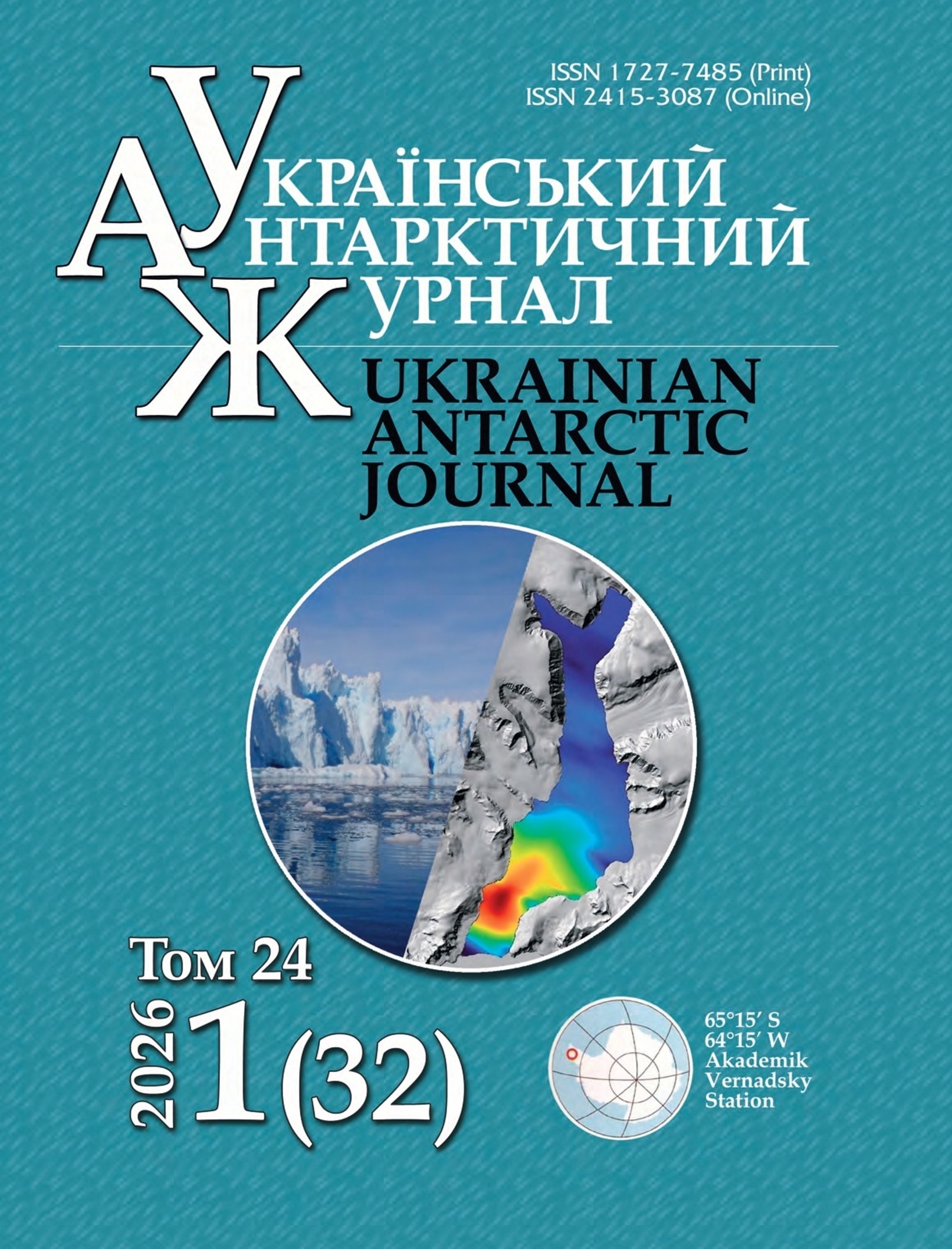
Spatial model of the Trooz Glacier dynamics based on meteorological data from the Akademik Vernadsky station
 Kornyliy Tretyak
- Denys Kukhtar
- ERA5,
- Fourier series,
- glacier acceleration,
- offset tracking,
- Sentinel-1
Copyright (c) 2026 Ukrainian Antarctic Journal

This work is licensed under a Creative Commons Attribution-NonCommercial-NoDerivatives 4.0 International License.
Abstract
This paper models the dynamics of the Trooz Glacier, Antarctic Peninsula. To integrate remote and meteorological data, we processed ice flow velocities derived from satellite radar imagery, air temperature, and precipitation obtained from the ERA5 reanalysis, and in situ meteorological observations from the Ukrainian Antarctic Akademik Vernadsky station. Glacier surface velocity was estimated using the offset-tracking method applied to Sentinel-1 satellite data for the period 2015–2025, generating 286 ice flow maps. An approach is developed to calculate air temperature over the glacier surface using in situ measurements from the remotely located Akademik Vernadsky station, in the absence of additional data. Spatial models of temperature and glacier velocity were constructed, accounting for additional parameters such as precipitation and glacier surface elevation above sea level. Time series analysis over the past decade indicates contrasting trends: increasing air temperature at the Akademik Vernadsky station (+0.12 °C/year) and decreasing temperatures over the glacier surface (–0.07 to –0.13 °C/year). A Fourier series approximation made it possible to clarify a seasonal pattern in glacier velocity. From the mean velocities, there is a tendency toward 1–4% acceleration in ice flow. Analysis of the model showed that air temperature and surface elevation together explain approximately 54% of the spatial variation in mean velocity, with the remaining variability attributable to other factors, including glacier bed geometry, ice thickness, subglacial drainage conditions, and local ice-flow morphology. The resulting spatial models can be used to further predict climate-driven changes in the glacier system.
References
- Bonshoms, M., Ubeda, J., Liguori, G., Körner, P., Navarro, Á., & Cruz, R. (2022). Validation of ERA5-Land temperature and relative humidity on four Peruvian glaciers using on-glacier observations. Journal of Mountain Science, 19(7), 1849–1873. https://doi.org/10.1007/s11629-022-7388-4
- Bromwich, D., Ensign, A. S., Wang, S.-H., & Zou, X. (2024). Major Artifacts in ERA5 2-m Air Temperature Trends over Antarctica Prior to and During the Modern Satellite Era. Preprints. https://doi.org/10.22541/essoar.172374138.80262922/v2
- Charrier, L., Dehecq, A., Guo, L., Brun, F., Millan, R., Lioret, N., Copland, L., Maier, N., Dow, C., & Halas, P. (2025). TICOI: An operational Python package to generate regular glacier velocity time series. The Cryosphere, 19(10), 4555–4583. https://doi.org/10.5194/tc-19-4555-2025
- Cheng, G., Morlighem, M., Mouginot, J., & Cheng, D. (2022). Helheim Glacier’s Terminus Position Controls Its Seasonal and Inter-Annual Ice Flow Variability. Geophysical Research Letters, 49(5), e2021GL097085. https://doi.org/10.1029/2021GL097085
- Christie, F. D. W., Benham, T. J., Batchelor, C. L., Rack, W., Montelli, A., & Dowdeswell, J. A. (2022). Antarctic ice-shelf advance driven by anomalous atmospheric and sea-ice circulation. Nature Geoscience, 15(5), 356–362. https://doi.org/10.1038/s41561-022-00938-x
- Christie, F. D. W., Steig, E. J., Gourmelen, N., Tett, S. F. B., & Bingham, R. G. (2023). Inter-decadal climate variability induces differential ice response along Pacific-facing West Antarctica. Nature Communications, 14(1), 93. https://doi.org/10.1038/s41467-022-35471-3
- Cicoira, A., Beutel, J., Faillettaz, J., Gärtner-Roer, I., & Vieli, A. (2019). Resolving the influence of temperature forcing through heat conduction on rock glacier dynamics: A numerical modelling approach. The Cryosphere, 13(3), 927–942. https://doi.org/10.5194/tc-13-927-2019
- Ciracì, E., Velicogna, I., & Swenson, S. (2020). Continuity of the Mass Loss of the World’s Glaciers and Ice Caps From the GRACE and GRACE Follow-On Missions. Geophysical Research Letters, 47(9), e2019GL086926. https://doi.org/10.1029/2019GL086926
- Climate Unboxed. (2021, April 2). The Beauty of NetCDF[Video recording]. https://www.youtube.com/watch?app=desktop&v=UvNBnjiTXa0&list
- Edwards, T. L., Nowicki, S., Marzeion, B., Hock, R., Goelzer, H., Seroussi, H., Jourdain, N. C., Slater, D. A., Turner, F. E., Smith, C. J., McKenna, C. M., Simon, E., Abe-Ouchi, A., Gregory, J. M., Larour, E., Lipscomb, W. H., Payne, A. J., Shepherd, A., Agosta, C., ... & Zwinger, T. (2021). Projected land ice contributions to twenty-first-century sea level rise. Nature, 593(7857), 74–82. https://doi.org/10.1038/s41586-021-03302-y
- Euillades, L. D., Euillades, P. A., Riveros, N. C., Masiokas, M. H., Ruiz, L., Pitte, P., Elefante, S., Casu, F., & Balbarani, S. (2016). Detection of glaciers displacement time-series using SAR. Remote Sensing of Environment, 184, 188–198. https://doi.org/10.1016/j.rse.2016.07.003
- Feng, X., Chen, Z., Li, G., Ju, Q., Yang, Z., & Cheng, X. (2023). Improving the capability of D-InSAR combined with offset-tracking for monitoring glacier velocity. Remote Sensing of Environment, 285, 113394. https://doi.org/10.1016/j.rse.2022.113394
- Forte, E., Santin, I., Azzaro, M., Battistel, D., & Guglielmin, M. (2024). Evidence of brines interconnections and different flow patterns within the boulder clay glacier and its moraine (Victoria Land, East Antarctica). Science of The Total Environment, 957, 177469. https://doi.org/10.1016/j.scitotenv.2024.177469
- Frederikse, T., Landerer, F., Caron, L., Adhikari, S., Parkes, D., Humphrey, V. W., Dangendorf, S., Hogarth, P., Zanna, L., Cheng, L., & Wu, Y.-H. (2020). The causes of sea-level rise since 1900. Nature, 584(7821), 393–397. https://doi.org/10.1038/s41586-020-2591-3
- Gardner, A. S., Sharp, M. J., Koerner, R. M., Labine, C., Boon, S., Marshall, S. J., Burgess, D. O., & Lewis, D. (2009). Near-Surface Temperature Lapse Rates over Arctic Glaciers and Their Implications for Temperature Downscaling. Journal of Climate, 22(16), 4281–4298. https://doi.org/10.1175/2009JCLI2845.1
- Gleixner, S., Demissie, T., & Diro, G. T. (2020). Did ERA5 Improve Temperature and Precipitation Reanalysis over East Africa? Atmosphere, 11(9), 996. https://doi.org/10.3390/atmos11090996
- Gomez, R., Arigony-Neto, J., De Santis, A., Vijay, S., Jaña, R., & Rivera, A. (2019). Ice dynamics of union glacier from SAR offset tracking. Global and Planetary Change, 174, 1–15. https://doi.org/10.1016/j.gloplacha.2018.12.012
- Gossart, A., Helsen, S., Lenaerts, J. T. M., Broucke, S. V., Lipzig, N. P. M. van, & Souverijns, N. (2019). An Evaluation of Surface Climatology in State-of-the-Art Reanalyses over the Antarctic Ice Sheet. Journal of Climate, 32(20), 6899–6915. https://doi.org/10.1175/JCLI-D-19-0030.1
- Hall, D. K., Box, J. E, Casey, K. A., Hook, S. J., Shuman, C. A., & Steffen, K. (2008). Comparison of satellite-derived and in situ observations of ice and snow surface temperatures over Greenland. Remote Sensing of Environment, 112(10), 3739–3749. https://doi.org/10.1016/j.rse.2008.05.007
- Hu, Y., Harrison, S., Liu, L., & Wood, J. L. (2023). Modelling rock glacier ice content based on InSAR-derived velocity, Khumbu and Lhotse valleys, Nepal. The Cryosphere, 17(6), 2305–2321. https://doi.org/10.5194/tc-17-2305-2023
- Hugonnet, R., McNabb, R., Berthier, E., Menounos, B., Nuth, C., Girod, L., Farinotti, D., Huss, M., Dussaillant, I., Brun, F., & Kääb, A. (2021). Accelerated global glacier mass loss in the early twenty-first century. Nature, 592(7856), 726–731. https://doi.org/10.1038/s41586-021-03436-z
- Jawak, S. D., Kumar, S., Luis, A. J., Pandit, P. H., Wankhede, S. F., & Anirudh, T. S. (2019). Seasonal comparison of velocity of the eastern tributary glaciers, Amery Ice Shelf, Antarctica, using SAR offset tracking. ISPRS Annals of the Photogrammetry, Remote Sensing and Spatial Information Sciences, IV-2-W5, 595–600. https://doi.org/10.5194/isprs-annals-IV-2-W5-595-2019
- Kadurin, S., & Andrieieva, K. (2021). Ice sheet velocity tracking by Sentinel-1 satellite images at Graham Coast Kyiv Peninsula. Ukrainian Antarctic Journal, (1), 24–31. https://doi.org/10.33275/1727-7485.1.2021.663
- Kadurin, S., & Kadurin, V. (2023). The dynamics of Trooz Glacier, Antarctic Peninsula, by satellite remote sensing data. Ukrainian Antarctic Journal, 21(2(27), 117–133. https://doi.org/10.33275/1727-7485.2.2023.713
- Khrystiuk, B., Gorbachova, L., Shpyg, V., & Pishniak, D. (2022). Changes in extreme temperature indices at the Ukrainian Antarctic Akademik Vernadsky station, 1951-2020. Meteorology, Hydrology and Water Management, 10(1), 95–106. https://doi.org/10.26491/mhwm/150883
- Lee, S., Kim, S., An, H., & Han, H. (2023). Ice Velocity Variations of the Cook Ice Shelf, East Antarctica, from 2017 to 2022 from Sentinel-1 SAR Time-Series Offset Tracking. Remote Sensing, 15(12), 3079. https://doi.org/10.3390/rs15123079
- Lo Vecchio, A., Lenzano, M. G., Durand, M., Lannutti, E., Bruce, R., & Lenzano, L. (2018). Estimation of surface flow speed and ice surface temperature from optical satellite imagery at Viedma glacier, Argentina. Global and Planetary Change, 169, 202–213. https://doi.org/10.1016/j.gloplacha.2018.08.001
- Łukosz, M., Hejmanowski, R., & Witkowski, W. T. (2022). Analysis of the Velocity Changes of the Jakobshavn Glacier Based on SAR Imagery. Quaestiones Geographicae, 41(1), 93–105. https://doi.org/10.2478/qua-geo-2022-0007
- Machío, F., Rodríguez-Cielos, R., Navarro, F., Lapazaran, J., & Otero, J. (2017). A 14-year dataset of in situ glacier surface velocities for a tidewater and a land-terminating glacier in Livingston Island, Antarctica. Earth System Science Data, 9(2), 751–764. https://doi.org/10.5194/essd-9-751-2017
- Mo, Z., Zeng, Z., Huang, Liangke, Liu, L., Huang, Ling, Zhou, L., Ren, C., & He, H. (2021). Investigation of Antarctic Precipitable Water Vapor Variability and Trend from 18 Year (2001 to 2018) Data of Four Re-analyses Based on Radiosonde and GNSS Observations. Remote Sensing, 13(19), 3901. https://doi.org/10.3390/rs13193901
- Mouginot, J., Rignot, E., & Scheuchl, B. (2019). Continent-Wide, Interferometric SAR Phase, Mapping of Antarctic Ice Velocity. Geophysical Research Letters, 46(16), 9710–9718. https://doi.org/10.1029/2019GL083826
- Nanni, U., Scherler, D., Ayoub, F., Millan, R., Herman, F., & Avouac, J.-P. (2023). Climatic control on seasonal variations in mountain glacier surface velocity. The Cryosphere, 17(4), 1567–1583. https://doi.org/10.5194/tc-17-1567-2023
- Neckel, N., Zeising, O., Steinhage, D., Helm, V., & Humbert, A. (2020). Seasonal Observations at 79 °N Glacier (Greenland) From Remote Sensing and in situ Measurements. Frontiers in Earth Science, 8, 142. https://doi.org/10.3389/feart.2020.00142
- Nicola, L., Notz, D., & Winkelmann, R. (2023). Revisiting temperature sensitivity: How does Antarctic precipitation change with temperature? The Cryosphere, 17(7), 2563–2583. https://doi.org/10.5194/tc-17-2563-2023
- Noad, N. C., Bonnaventure, P. P., Gilson, G. F., Jiskoot, H., & Garibaldi, M. C. (2023). Surface-based temperature inversion characteristics and impact on surface air temperatures in northwestern Canada from radiosonde data between 1990 and 2016. Arctic Science, 9(3), 545–563. https://doi.org/10.1139/as-2022-0031
- Otosaka, I. N., Horwath, M., Mottram, R., & Nowicki, S. (2023). Mass Balances of the Antarctic and Greenland Ice Sheets Monitored from Space. Surveys in Geophysics, 44(5), 1615–1652. https://doi.org/10.1007/s10712-023-09795-8
- Parkes, D., & Marzeion, B. (2018). Twentieth-century contribution to sea-level rise from uncharted glaciers. Nature, 563(7732), 551–554. https://doi.org/10.1038/s41586-018-0687-9
- Rignot, E., Mouginot, J., Scheuchl, B., van den Broeke, M., van Wessem, M. J., & Morlighem, M. (2019). Four decades of Antarctic Ice Sheet mass balance from 1979–2017. Proceedings of the National Academy of Sciences, 116(4), 1095–1103. https://doi.org/10.1073/pnas.1812883116
- Rosas-Chavoya, M., López-Serrano, P. M., Hernández-Díaz, J. C., Wehenkel, C., & Vega-Nieva, D. J. (2022). Analysis of Near-Surface Temperature Lapse Rates in Mountain Ecosystems of Northern Mexico Using Land-sat-8 Satellite Images and ECOSTRESS. Remote Sensing, 14(1), 162. https://doi.org/10.3390/rs14010162
- Rounce, D. R., Hock, R., Maussion, F., Hugonnet, R., Kochtitzky, W., Huss, M., Berthier, E., Brinkerhoff, D., Compagno, L., Copland, L., Farinotti, D., Menounos, B., & McNabb, R. W. (2023). Global glacier change in the 21st century: Every increase in temperature matters. Science, 379(6627), 78–83. https://doi.org/10.1126/science.abo1324
- Roussel, M.-L., Lemonnier, F., Genthon, C., & Krinner, G. (2020). Brief communication: Evaluating Antarctic precipitation in ERA5 and CMIP6 against CloudSat observations. The Cryosphere, 14(8), 2715–2727. https://doi.org/10.5194/tc-14-2715-2020
- Sanchez Lofficial, A., Métivier, L., Fleitout, L., Chanard, K., Greff-Lefftz, M., de La Serve, M., Gauer, L.-M.,& Gourrion, E. (2025). Multitechnique estimation of ice mass balance in Greenland: Impact of the uncertainties on firn densification and GIA models. Geophysical Journal International, 240(3), 1935–1952. https://doi.org/10.1093/gji/ggaf015
- Still, H., Odolinski, R., Bowman, M. H., Hulbe, C., & Prior, D. J. (2024). Observing glacier dynamics with low-cost, multi-GNSS positioning in Victoria Land, Antarctica. Journal of Glaciology, 70, e31. https://doi.org/10.1017/jog.2023.101
- Tetzner, D., Thomas, E., & Allen, C. (2019). A Validation of ERA5 Reanalysis Data in the Southern Antarctic Peninsula—Ellsworth Land Region, and Its Implications for Ice Core Studies. Geosciences, 9(7), 289. https://doi.org/10.3390/geosciences9070289
- Tretyak, K. R., & Kukhtar, D. V. (2023). Modeling the Trooz Glacier’s movement using air temperature data and satellite SAR observations in 2015–2022. Ukrainian Antarctic Journal, 21(1(26), 24–36. https://doi.org/10.33275/1727-7485.1.2023.709
- Vijay, S., & Braun, M. (2017). Seasonal and Interannual Variability of Columbia Glacier, Alaska (2011–2016): Ice Velocity, Mass Flux, Surface Elevation and Front Position. Remote Sensing, 9(6), 635. https://doi.org/10.3390/rs9060635
- Wallis, B. J., Hogg, A. E., Meredith, M. P., Close, R., Hardy, D., McMillan, M., Wuite, J., Nagler, T., & Moffat, C. (2023). Ocean warming drives rapid dynamic activation of marine-terminating glacier on the west Antarctic Peninsula. Nature Communications, 14(1), 7535. https://doi.org/10.1038/s41467-023-42970-4
- Wen, Q., & Wang, T. (2025). Time-Series Surface Velocity and Backscattering Coefficients from Sentinel-1 SAR Images Document Glacier Seasonal Dynamics and Surges on the Puruogangri Ice Field in the Central Tibetan Plateau. Remote Sensing, 17(20), 3490. https://doi.org/10.3390/rs17203490
- Wille, J. D., Favier, V., Jourdain, N. C., Kittel, C., Turton, J. V., Agosta, C., Gorodetskaya, I. V., Picard, G., Codron, F., Santos, C. L.-D., Amory, C., Fettweis, X., Blanchet, J., Jomelli, V., & Berchet, A. (2022). Intense atmospheric rivers can weaken ice shelf stability at the Antarctic Peninsula. Communications Earth & Environment, 3(1), 90. https://doi.org/10.1038/s43247-022-00422-9
- Winsvold, S. H., Kääb, A., & Nuth, C. (2016). Regional Glacier Mapping Using Optical Satellite Data Time Series. IEEE Journal of Selected Topics in Applied Earth Observations and Remote Sensing, 9(8), 3698–3711. https://doi.org/10.1109/JSTARS.2016.2527063
- Wuite, J., Nagler, T., Hetzenecker, M., & Rott, H. (2026). Ten years of polar ice velocity mapping using Copernicus Sentinel-1. Remote Sensing of Environment, 332, 115092. https://doi.org/10.1016/j.rse.2025.115092
- Yang, W., Zhao, C., Westoby, M., Yao, T., Wang, Y., Pellicciotti, F., Zhou, J., He, Z., & Miles, E. (2020). Seasonal Dynamics of a Temperate Tibetan Glacier Revealed by High-Resolution UAV Photogrammetry and In Situ Measurements. Remote Sensing, 12(15), 2389. https://doi.org/10.3390/rs12152389
- Zekollari, H., Huss, M., Farinotti, D., & Lhermitte, S. (2022). Ice-Dynamical Glacier Evolution Modeling–A Review. Reviews of Geophysics, 60(2), e2021RG000754. https://doi.org/10.1029/2021RG000754
- Zhang, J., Jia, L., Menenti, M., & Ren, S. (2021). Interannual and Seasonal Variability of Glacier Surface Velocity in the Parlung Zangbo Basin, Tibetan Plateau. Remote Sensing, 13(1), 80. https://doi.org/10.3390/rs13010080
- Zhang, T., Xiao, C., Colgan, W., Qin, X., Du, W., Sun, W., Liu, Y., & Ding, M. (2013). Observed and modelled ice temperature and velocity along the main flowline of East Rongbuk Glacier, Qomolangma (Mount Everest), Himalaya. Journal of Glaciology, 59(215), 438–448. https://doi.org/10.3189/2013JoG12J202