


Мікрокліматична мінливість притоку сонячної радіації та наявності снігового покриву поблизу аборигенних судинних рослин морської Антарктики
 Михайло Савенець
- Лариса Писаренко
- Антон Пуговкін
- Наталія Мірюта
- Денис Пішняк
- Іван Парнікоза
- Антарктика,
- інтенсивність,
- мікроклімат,
- освітлення,
- перлинниця антарктична
- танення снігу,
- щучник антарктичний ...Більше
Авторське право (c) 2026 Український антарктичний журнал

Ця робота ліцензується відповідно до Creative Commons Attribution-NonCommercial-NoDerivatives 4.0 International License.
Анотація
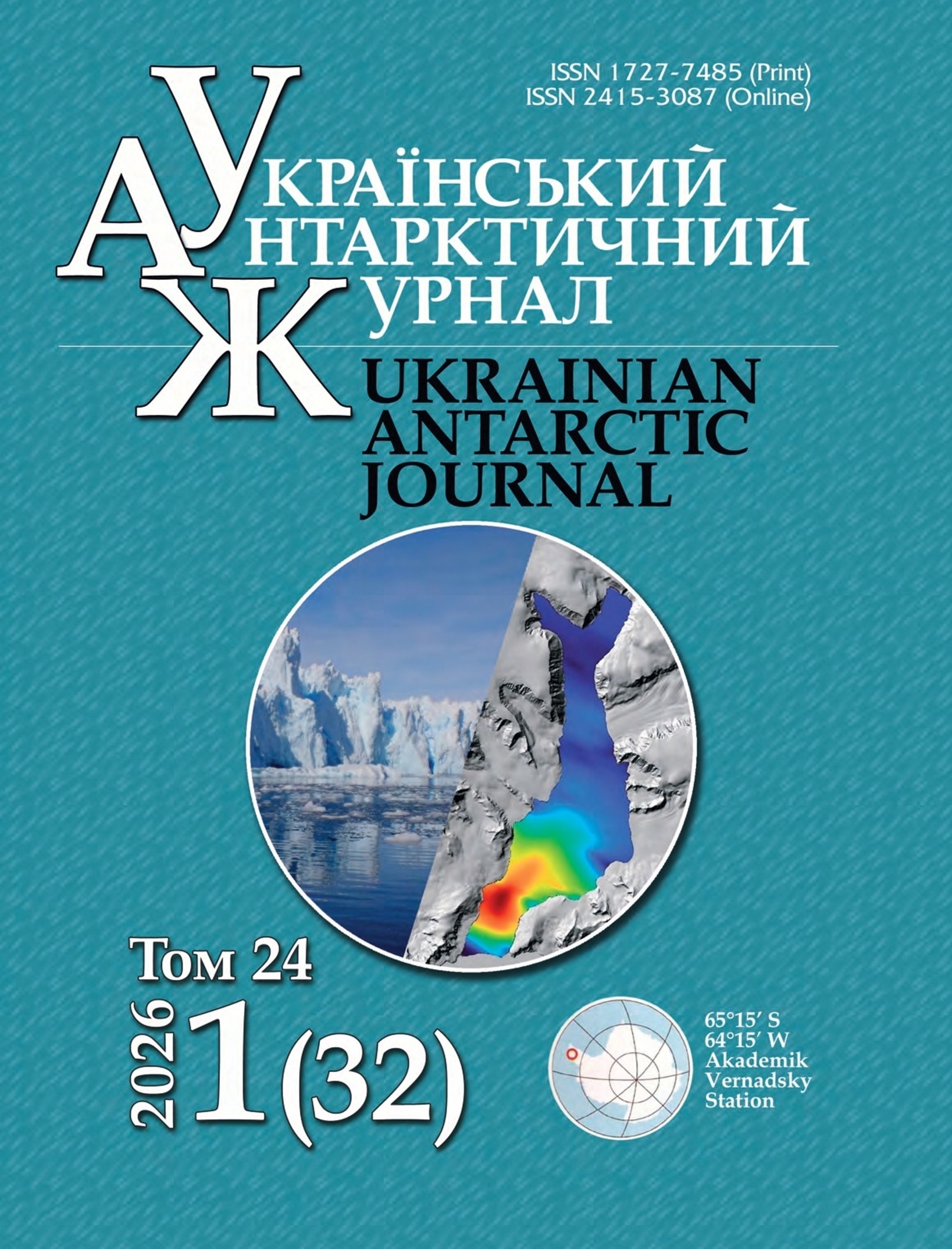
Прихідний потік сонячного випромінювання є важливим фактором виживання місцевих судинних рослин Антарктики, який формує основне джерело енергії для місцевої наземної рослинності. Нами проаналізовано мікрокліматичну мінливість притоку сонячного випромінювання до земної поверхні та оцінено придатність до використання у якості проксі-параметра з метою ідентифікації наявності снігового покриву у віддалених регіонах. Дослідження проведені на основі мережі 38 логерів температури та освітленості на полігоні, що охоплює район Аргентинських островів – півострова Київ, за період 2017–2025 рр. У масштабі мікроумов, де поширені Colobanthus quitensis та Deschampsia antarctica, типові середні літні значення сонячної радіації складають 200–500 В ⋅ м–2, з відхиленнями до ±60% від середніх багаторічних значень через мікрокліматичні особливості. Ми проаналізували періоди з майже нульовою освітленістю, яка вказує на стійкий сніговий покрив, що типово спостерігається у період з квітня по жовтень. Будучи виміряним біля поверхні, зникнення сонячного випромінювання може слугувати проксіпараметром наявності снігового покриву. Дати формування стійкого снігового покриву були близькі, а дати танення – значно відмінні. У місцях поширення місцевих судинних рослин період без снігу варіює в межах від 90 до 200 днів та залежить від мікрокліматичних особливостей. Не було виявлено статистично надійних різниць показників річного циклу притоку сонячної радіації між локаціями з C. quitensis and D. antarctica. Проте виявлено, що для перлинниці більш типовими ділянками можуть бути ті, які характеризуються довшим періодом освітленості. Проведені дослідження наголошують на необхідності врахування притоку сонячного випромінювання безпосередньо в мікромасштабі та показують потенціал сенсорів освітленості до використання у якості проксі-параметру оцінки наявності снігового покриву у віддалених районах Антарктики, де неможливо проводити інші прямі спостереження.
Посилання
- Andrade, A. M. de, Michel, R. F. M., Bremer, U. F., Schaefer, C. E. G. R., & Simões, J. C. (2018). Relationship between solar radiation and surface distribution of vegetation in Fildes Peninsula and Ardley Island, Maritime Antarctica. International Journal of Remote Sensing, 39(8), 2238–2254. https://doi.org/10.1080/01431161.2017.1420937
- Bai, J., Zong, X., Lanconelli, C., Lupi, A., Driemel, A., Vitale, V., Li, K., & Song, T. (2022). Long-Term Variations of Global Solar Radiation and Its Potential Effects at Dome C (Antarctica). International Journal of Environmental Research and Public Health, 19(5), 3084. https://doi.org/10.3390/ijerph19053084
- Balog, I., Spinelli, F., Grigioni, P., Caputo, G., Napoli, G., & de Silvestri, L. (2019). Estimation of Direct Normal Irradiance at Antarctica for Concentrated Solar Technology. Applied System Innovation, 2(3), 21. https://doi.org/10.3390/asi2030021
- Barrera, A., Hereme, R., Ruiz-Lara, S., Larrondo, L. F., Gundel, P. E., Pollmann, S., Molina-Montenegro, M. A., & Ramos, P. (2020). Fungal Endophytes Enhance the Photoprotective Mechanisms and Photochemical Efficiency in the Antarctic Colobanthus quitensis (Kunth) Bartl. Exposed to UV-B Radiation. Frontiers in Ecology and Evolution, 8, 122. https://doi.org/10.3389/fevo.2020.00122
- Cannone, N., Guglielmin, M., Convey, P., Worland, M. R., & Favero Longo, S. E. (2016). Vascular plant changes in extreme environments: effects of multiple drivers. Climatic Change, 134, 651–665. https://doi.org/10.1007/s10584-015-1551-7
- Dana, G. L., Wharton, R. A., Jr., & Dubayah, R. A. (1998). Solar Radiation in the Mcmurdo Dry Valleys, Antarctica. In J. C. Priscu (Ed.), Ecosystem Dynamics in a Polar Desert: the Mcmurdo Dry Valleys, Antarctica (pp. 39–64). https://doi.org/10.1029/AR072p0039
- Day, T. A., Ruhland, C. T., & Xiong, F. S. (2001). Influence of solar ultraviolet-B radiation on Antarctic terrestrial plants: results from a 4-year field study. Journal of Photochemistry and Photobiology B: Biology, 62(1–2), 78–87. https://doi.org/10.1016/S1011-1344(01)00161-0
- di Carmine, C., Campanelli, M., Nakajima, T., Tomasi, C., & Vitale, V. (2005). Retrievals of Antarctic aerosol characteristics using a Sunsky radiometer during the 2001–2002 austral summer campaign. Journal of Geophysical Research: Atmospheres, 110(D13), D13202. https://doi.org/10.1029/2004JD005280
- Ding, M., Agrawal, A., Heil, P., & Yang, D. (2019). Surface energy balance on the Antarctic plateau as measured with an automatic weather station during 2014. Advances in Polar Science, 30(2), 93–105. https://doi.org/10.13679/j.advps.2018.0050 https://library.arcticpor-tal.org/2685/1/A1902002.pdf
- Katurji, M., Zawar-Reza, P., & Zhong, S. (2013). Surface layer response to topographic solar shading in Antarctica’s dry valleys. Journal of Geophysical Research: Atmospheres, 118(22), 12,332–12,344. https://doi.org/10.1002/2013JD020530
- Khrystiuk, B., Gorbachova, L., Shpyg, V., Pishniak, D., & Klok, S. (2026). Estimation of snow cover melting characteristics from Vernadsky weather station data (Antarctica). Meteorology Hydrology and Water Management, 14(1), 106–118. https://doi.org/10.26491/mhwm/217541
- Láska, K., Prošek, P., Budík, L., Budíková, M., & Milinevsky, G. (2009). Prediction of erythemally effective UVB radiation by means of nonlinear regression model. Environmetrics, 20(6), 633–646. https://doi.org/10.1002/env.968
- Matos, P., Rocha, B., Pinho, P., Miranda, V., Pina, P., Goyanes, G., & Vieira, G. (2024). Microscale is key to model current and future Maritime Antarctic vegetation. Science of The Total Environment, 946, 174171. https://doi.org/10.1016/j.scitotenv.2024.174171
- Miryuta, N., Parnikoza, I., Oliinyk, M., Smetana, E., Myryuta, G., Poronnik, O., & Kunakh, V. (2017). Five seasons dynamic of adaptability united latent quality indicator of Deschampsia antarctica (Poaceae) population of Galindez Island (Argentine Islands, maritime Antarсtic). Ukrainian Antarctic Journal, (16), 129–142. https://doi.org/10.33275/1727-7485.16.2017.71
- Miryuta, N., Savenets, M., Pysarenko, L., Myryuta, G., Poronnik, O., & Parnikoza, I. (2025). Spatio-temporal variability of soil surface temperature affects adaptation of Antarctic hairgrass populations. 1. Fluctuations of average monthly local temperature near plants influence biometrical, biochemical, and ecological characteristics. Czech Polar Reports, 15(2), 285–302. https://doi.org/10.5817/CPR2025-2-17
- Obryk, M. K., Fountain, A. G., Doran, P. T., Lyons, W. B., & Eastman, R. (2018). Drivers of solar radiation variability in the McMurdo Dry Valleys, Antarctica. Scientific Reports, 8(1), 5002. https://doi.org/10.1038/s41598-018-23390-7
- Pannewitz, S., Schlensog, M., Allan Green, T. G., Sancho, L. G., & Schroeter, B. (2003). Are Lichens Active under Snow in Continental Antarctica? Oecologia, 135(1), 30–38. https://www.jstor.org/stable/4223554
- Petkov, B. H., Láska, K., Vitale, V., Lanconelli, C., Lupi, A., Mazzola, M., & Budíková, M. (2016). Variability in solar irradiance observed at two contrasting Antarctic sites. Atmospheric Research, 172–173, 126–135. https://doi.org/10.1016/j.atmosres.2016.01.005
- Raggio, J., Green, T. G. A., & Sancho, L. G. (2016). In situ monitoring of microclimate and metabolic activity in lichens from Antarctic extremes: a comparison between South Shetland Islands and the McMurdo Dry Valleys. Polar Biology, 39(1), 113–122. https://doi.org/10.1007/s00300-015-1676-1
- Ramírez, C. F., Cavieres, L. A., Sanhueza, C., Vallejos, V., Gómez-Espinoza, O., Bravo, L. A., & Sáez, P. L. (2024). Ecophysiology of Antarctic Vascular Plants: An Update on the Extreme Environment Resistance Mechanisms and Their Importance in Facing Climate Change. Plants, 13(3), 449. https://doi.org/10.3390/plants13030449
- Savenets, M., Pysarenko, L., Krakovska, S., Parnikoza, I., & Pishniak, D. (2023). Local temperature near native vascular plants in the Argentine Islands–Kyiv Peninsula region, Antarctic Peninsula: annual variability and approximation using standard meteorological measurements. Polar Research, 42, 8339. https://doi.org/10.33265/polar.v42.8339
- Schroeter, B., Green, T. G. A., Pannewitz, S., Schlensog, M., & Sancho, L. G. (2011). Summer variability, winter dormancy: lichen activity over 3years at Botany Bay, 77°S latitude, continental Antarctica. Polar Biology, 34(1), 13–22. https://doi.org/10.1007/s00300-010-0851-7
- Shpyg, V., Shchehlov, O., & Pishniak, D. (2024). Snow cover at the Akademik Vernadsky station: response on wind, temperature and precipitation variations. Ukrainian Antarctic Journal, 22(1(28), 6–23. https://doi.org/10.33275/1727-7485.1.2024.724
- Soares, J., Alves, M., Ribeiro, F. N. D., & Codato, G. (2019). Surface radiation balance and weather conditions on a non-glaciated coastal area in the Antarctic region. Polar Science, 20(2), 117–128. https://doi.org/10.1016/j.polar.2019.04.001
- Stanhill, G., & Cohen, S. (1997). Recent Changes in Solar Irradiance in Antarctica. Journal of Climate, 10(8), 2078–2086. https://doi.org/10.1175/1520-0442(1997)010<2078:RCISII>2.0.CO;2
- Szymszová, S., Láska, K., Kim, S.-J., & Park, S.-J. (2025). Variability of solar radiation and cloud cover in the Antarctic Peninsula region. Atmospheric Research, 316, 107940. https://doi.org/10.1016/j.atmosres.2025.107940
- Tarca, G., Guglielmin, M., Convey, P., Worland, M. R., & Cannone, N. (2022). Small-scale spatial-temporal variability in snow cover and relationships with vegetation and climate in maritime Antarctica. CATENA, 208, 105739. https://doi.org/10.1016/j.catena.2021.105739
- van den Broeke, M., Reijmer, C., & van de Wal, R. (2004). Surface radiation balance in Antarctica as measured with automatic weather stations. Journal of Geophysical Research: Atmospheres, 109(D9). https://doi.org/10.1029/2003JD004394
- Yevchun, H., Fedchuk, A., Drohushevska, I., Pnyovska, O., Chernyshenko, M., & Parnikoza, I. (2021). The Toponymy of the Argentine Islands area, the Kyiv Peninsula (West Antarctica). Ukrainian Antarctic Journal, (2), 127—157. https://doi.org/10.33275/1727-7485.2.2021.683
- Yu, L., Yang, Q., Zhou, M., Lenschow, D. H., Wang, X., Zhao, J., Sun, Q., Tian, Z., Shen, H., & Zhang, L. (2019). The variability of surface radiation fluxes over landfast sea ice near Zhongshan station, east Antarctica during austral spring. International Journal of Digital Earth, 12(8), 860–877. https://doi.org/10.1080/17538947.2017.1304458
- Zeng, Z., Wang, X., Wang, Z., Zhang, W., Zhang, D., Zhu, K., Mai, X., Cheng, W., & Ding, M. (2022). A 35-year daily global solar radiation dataset reconstruction at the Great Wall Station, Antarctica: First results and comparison with ERA5, CRA40 reanalysis, and ICDR (AVHRR) satellite products. Frontiers in Earth Science, 10, 961799. https://doi.org/10.3389/feart.2022.961799
- Zhang, T., Zhou, C., & Zheng, L. (2019). Analysis of the temporal-spatial changes in surface radiation budget over the Antarctic sea ice region. Science of The Total Environment, 666, 1134–1150. https://doi.org/10.1016/j.scitotenv.2019.02.264